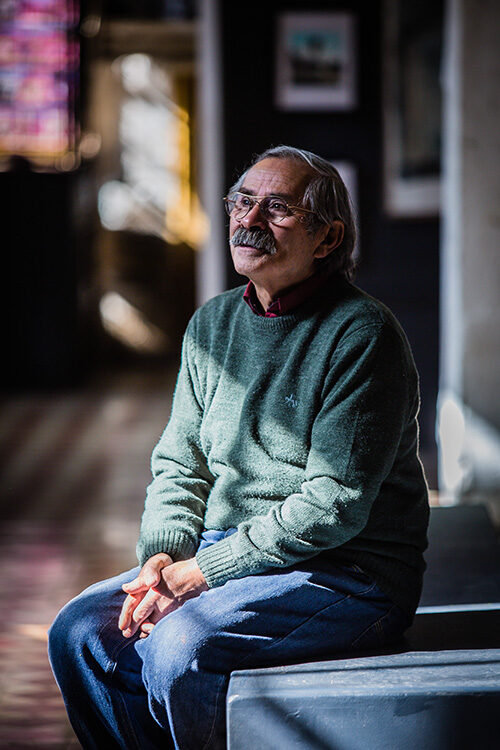
Name: Alejandro Mono González.
Booth name: Galería Taller Del Mono.
N° the booth: 204
Galpón: 6

Alejandro “Mono” González is a Chilean artist and set designer, recognized both nationally and internationally for his long career and for his colorful mural works with social themes. Many of his pieces portray the faces of immigrants and Indigenous people from the Amazon, and he uses multiple colors, as he says, “to lift the spirits of Chileans.”
Alejandro, why did you set up the Galería Taller del Mono at the Persa?
The idea of my gallery is not only to exhibit works of art but also to talk about printmaking and its different techniques. This comes from a workshop I saw in Marseille, in warehouses similar to these, and the idea is that people can see how the works they like are actually made.
What products do you sell?
I sell screen prints, woodcuts, and engravings. I want to emphasize that I never produce more than 100 copies of a piece; in fact, right now I’m making series of just 50, basically because I want to give exclusivity so that only 50 people own that design. The idea is not mass production, but rather variety. In addition, we are having the gallery sponsor exhibitions in cultural centers outside this district — we’ve taken shows to Puente Alto, San Joaquín, and now to Puerto Natales — all thanks to the connections and relationships we’ve built here at the Persa. The Persa is more than a business; it’s a place of connections.
And before, where was your workshop?
My workshop was at my house, but here I’m able to take advantage of other opportunities. The interesting thing about the Persa is that we are in a warehouse where other products are sold — for example, CDs, movies, and games. So people come looking for those things and then come across this. This is a gallery to spread popular art.

What generation are the people who visit your gallery from?
There are older people, professionals who buy artworks or who are collectors, but also young people — recent graduates, professionals, etc. — who are setting up their houses or apartments and are investing in buying art, either because they’ve seen murals on the streets or because they know the artist’s name. That audience is very interesting.
And thanks to your career, you already have a defined audience…
Yes, there are many people who come from abroad — from Spain, France, Italy, the United States, and Canada.
How did you become known in the art world?
I studied art, and I am a set designer. I worked on set designs for film and television. I am known in cinema — I designed the sets for films such as Machuca, La Fiebre del Loco, La Frontera, among others.
Did you live outside of Chile for some time?
No, but I travel a lot. I have painted several times in France, in Spain, and in Canada. I have painted murals in international museums.
Is there a country that has inspired your works?
Yes, Italy. I have been there several times. I’ve traveled, enriched myself, learned, and also made friends — many friends.

Do you enjoy being at the Persa?
I have fun. If I were at home on a Saturday or Sunday, I’d get bored. Here, I talk all day long.
How do you see the projection of the Persa as a hub for urban art? Do you see potential?
Because of the public, of course there is. Urban art is characterized by being in a place where there is a large audience. With globalization, there is a lot of exchange.
Have you always dedicated yourself to the art world?
Yes, always. With sacrifice. Many people ask me why I’m not working abroad, and I tell them, “This is my country, this is my home.” I used to come to this neighborhood to shop every weekend. This is an old man’s project, to close circles.
Is it like going back to your origins?
Exactly. It has to do with territorial identities.
What message would you give to people to encourage them to come see your works?
The first thing they’ll find is that we’ll be able to talk — that is, they’ll be able to speak directly with the creator, ask me questions, and I’ll get to know them too. I can explain the works and the techniques. It’s a gallery that spreads art, but also educates… and I learn as well.